
Reviewed · PRIVATE
NATO Bombing of Belgrade Private Tour
What makes this tour interesting is that the 1999 NATO bombing is not just a chapter in a book. It is written into Belgrade’s buildings, monuments, and street-level memories. I like the private pace, and I like how your English-speaking guide ties the headlines to what you can actually see.
I also love that the stops are admission free. That means you are paying for time with a guide and a vehicle, not for a stack of tickets. Each stop is planned for about 30 minutes, so you get depth without feeling dragged along.
One consideration: the subject is serious. You will hear stories connected to deaths and destruction, so it is not the best choice for a light, casual sightseeing day.
Key things you will notice on this tour
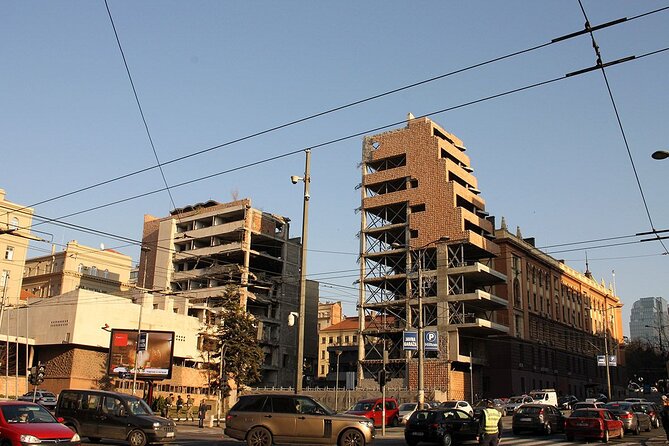
- Five major 1999 bombing-related sites in a logical route across Belgrade, from RTS to the Air Force Command building
- A guided timeline grounded in places, using on-site explanation (and visual support) to connect the dates to real locations
- Hotel pickup and drop-off included, so you can focus on the story instead of navigating unfamiliar streets
- Free admission at every stop, which keeps the cost focused on the private guide experience
- About 3 to 4 hours total, with roughly 30 minutes per location for a steady pace
A half-day Belgrade route through the NATO bombing of 1999
This is a private, English-language history tour focused on some of the most well-known NATO bombing sites in Belgrade. The premise is simple but powerful: you do not just read about what happened in 1999. You stand near the same structures and memorial references that keep the memory alive.
You can think of it as a moving history lesson. Your guide builds a timeline as you go, and you see how different targets, from TV facilities to military command buildings, translated into real damage. The experience works best when you allow yourself to stay present, even when the stories get uncomfortable.
It is also practical. In about 3 to 4 hours, you cover five stops that would take real effort to plan and connect on your own. If you want a structured route with context, this format is hard to beat.
More Belgrade ideas on the table
- Private Red Star-Partizan Stadium Tour in Belgrade
★ 5.0 · 72 reviews - Belgrade Private City Tour
★ 5.0 · 41 reviews - Private Transfer
★ 5.0 · 40 reviews
Hotel pickup at 10:00 makes the day start on rails
The tour starts at 10:00 am and includes hotel pickup and drop-off. That matters more than it sounds. Belgrade can be straightforward in the center, but trying to self-navigate a multi-stop “memory route” can turn into wasted time and missed context.
You also get bottled water, which is a small inclusion that makes the day feel smoother. The tour is private, meaning only your group participates, so you are not squeezed into a big crowd while your guide is explaining sensitive material.
If you are arriving by cruise or your lodging is not a standard hotel address, pickup can also be arranged from Belgrade port and from other locations such as an Airbnb or apartment. You just need to specify your pickup point when booking.
Stop 1: RTS and the Zašto monument at the ruined TV building
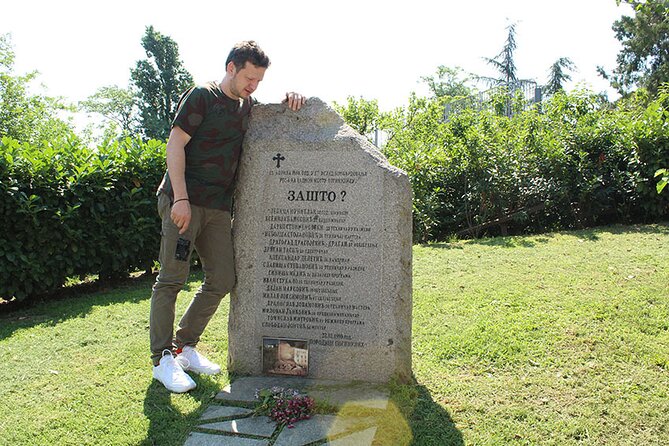
Your first stop is the RTS building, the Radio Television of Serbia site. Right there, at the monument called Zašto? (Why?), the story is explained from the perspective of the night shift and the people who were there.
This is one of the most affecting parts of the route, because the memorial framing is physical. The information points to a night in 1999 when 16, mostly young people, were killed during the night shift, and the building you see is described as an original structure that remains unrepaired as a memorial to that event.
Why this stop matters: TV and radio are not abstract targets. They are about communication, daily life, and the routine of a city. Standing at RTS with the Zašto monument in view gives you a strong sense of how the bombing story is not only about military strategy. It is also about civilians and the fear that spreads when normal life gets interrupted.
Practical tip: This stop is time-boxed to about 30 minutes. If you want to take notes or pause to absorb the memorial setting, keep your pace calm and plan to listen first, then look.
Stop 2: Ministry of Defence, April 29, 1999, and why proximity matters
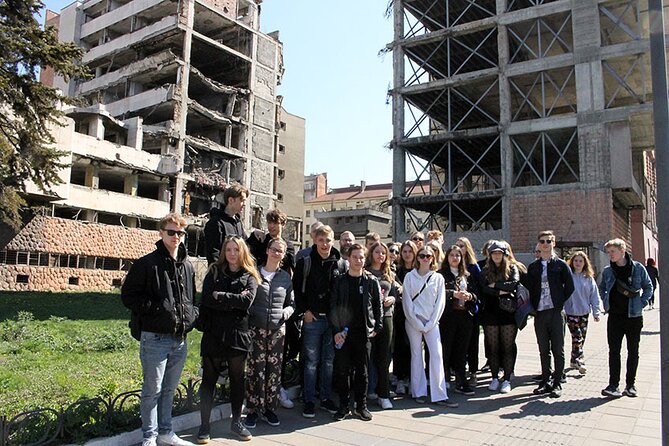
From RTS, you head to the Ministry of Defence area, a target that frequently appears in photos and references connected to the NATO bombing of Belgrade.
Here, the emphasis is on the night of 29 April 1999, when many military objectives were hit. The account also includes the human and neighborhood impact: one person lost their life, and many civilian buildings in the vicinity were damaged.
What I like about this stop is the shift it forces in your thinking. It is easy to talk about “objectives” in an abstract way. This explanation makes it clear that strikes have spillover effects, including damage to nearby civilian structures.
This stop is also about recognition. You are likely to have seen the Ministry of Defence image before, but the guide’s storytelling is what gives it weight. You understand the connection between that well-known photo and the lived consequences happening around it.
You will spend about 30 minutes here, with no admission fee required for the visit.
Leave Belgrade for a day, differently:
- From Belgrade: Novi Sad & Sremski Karlovci Full-Day Tour
★ 4.7 · 1,068 reviews - From Belgrade: Gems of Eastern Serbia Tour
★ 5.0 · 427 reviews - Northern Serbia: Sremski Karlovci and Novi Sad Full-Day Tour from Belgrade
★ 5.0 · 425 reviews - Day Trip from Belgrade: Gems of Eastern Serbia
★ 5.0 · 424 reviews
Stop 3: Ušće Business Center and the communist HQ skeleton
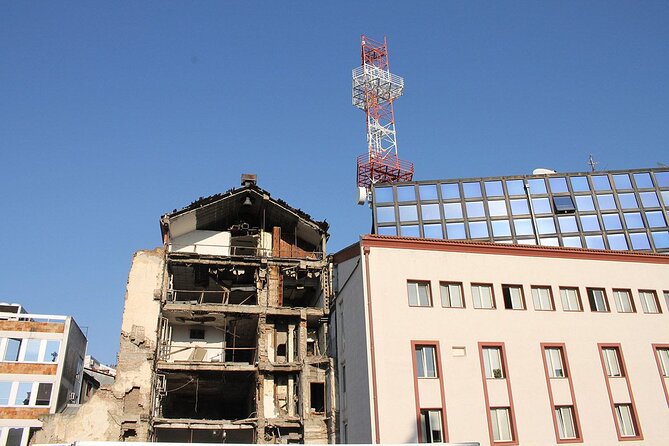
Next comes a location that looks like a modern business center, but the meaning is layered. Ušće Business Center is described as occupying the former Central Committee of the Communist Party of Yugoslavia space. The key point is that the building you see today follows the “skeleton” of what existed before.
The tour explanation focuses on two linked questions. First, why this building was described as NATO missile proof back in 1999. Second, why it was still targeted in the first place.
That back-and-forth is where your brain starts working in a different way. Instead of only hearing what happened, you also get nudged toward cause and contradiction: protections, intelligence, strategy, and how those ideas collide in the real world.
Also, it helps you see the city as something more than a set of landmarks. Belgrade becomes a place where politics, architecture, and military history overlap in one structure.
Like the other stops, you get about 30 minutes here and the visit is admission free.
Stop 4: Chinese Cultural Center, a controversial embassy site and May 7, 1999
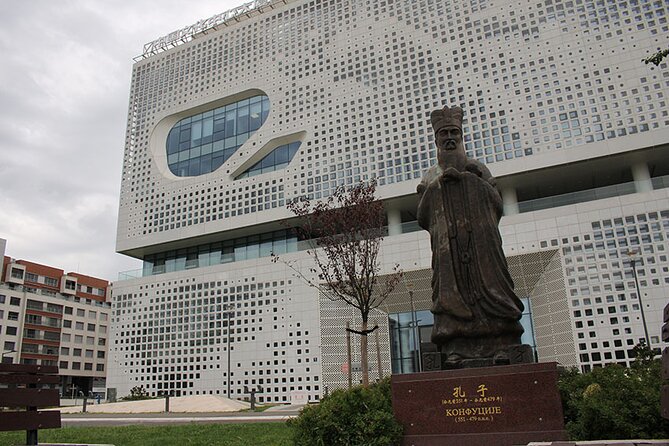
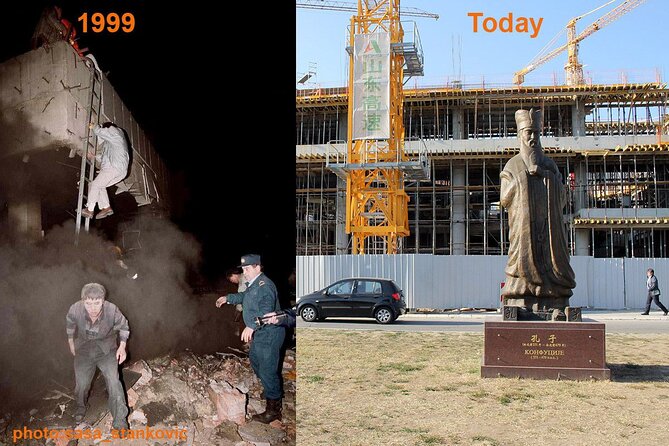
The fourth stop is the Chinese Cultural Center, tied to the former Chinese embassy. This is described as one of the most controversial bombing sites from the 1999 campaign.
The tour explanation includes two competing narratives about why it happened. The embassy was allegedly bombed due to an intelligence mistake, but there is also suspicion that it had a different purpose than what was assumed. Then the guide grounds the controversy in a concrete tragedy: four Chinese citizens died on the night of 7 May 1999.
This part of the tour is emotionally serious. It is also intellectually honest in the sense that it presents how uncertainty and assumptions can shape real outcomes. You do not just get one neat explanation. You get a recognition that information gaps and interpretation can have lethal results.
Why you should pay attention here: this stop broadens the story beyond Belgrade’s local targets. It connects the bombing campaign to international consequences and to how foreign communities got caught in events they did not choose.
Time is again about 30 minutes, and there is no admission ticket required for the stop.
Stop 5: Air Force Command Building, April 5, 1999, and the pilots’ defense
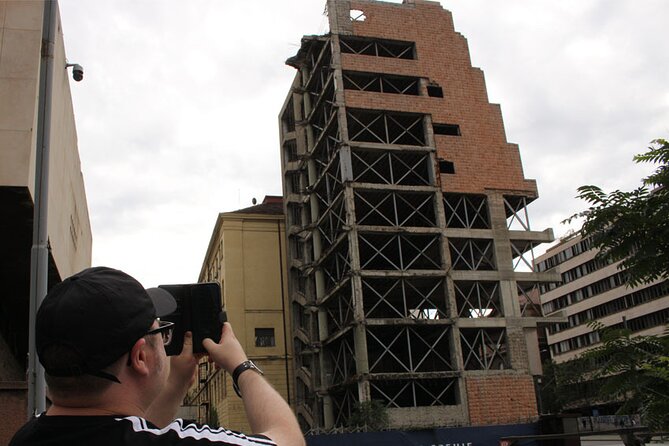
The final stop is the Air Force Command building. It is described as a 1935 structure with noted Yugoslav and Serbian architectural character, and it functions in the tour as both a place and a symbol of defense.
The key date here is 5 April 1999, when the building was hit with two missiles. What your guide adds at this stage is the human story behind the target. The explanation includes the idea of pilots who knowingly engaged and ultimately lost their lives defending the sky above Serbia and Yugoslavia against a much stronger NATO air force.
This stop gives the route a different tone than the earlier ones. RTS and the Ministry of Defence are framed through civilian impact and strategic targeting. The Air Force Command building brings in a defense perspective and emphasizes sacrifice.
If you want to understand why people in the region remember 1999 so personally, this is where the tour helps you connect the history to lived identity. It is not only about damage. It is about courage and loss, described from the side of those who were on duty.
You spend about 30 minutes here, with admission free entry.
How the guide turns street-level stops into a clear timeline
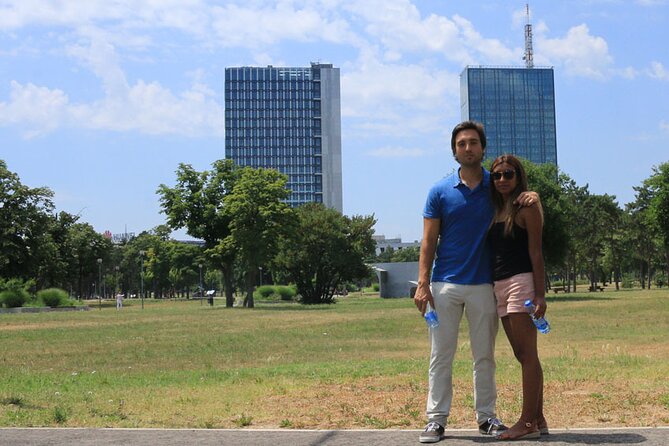
What makes this tour feel genuinely educational is not just the list of sites. It is the way the story is organized for you as you move.
You get a narrative thread that ties the tour into specific nights and dates: the night-shift deaths at RTS, the 29 April 1999 Ministry of Defence bombing impact, the questions around Ušće’s missile protection and why it was hit, the 7 May 1999 embassy tragedy, and then the 5 April 1999 strike associated with the Air Force Command building.
Your guide also uses visuals, including pictures, to make the background easier to grasp. That kind of support matters a lot when you are standing in front of buildings that have changed function over time. Photos help you map what you are seeing now to what was happening then.
And because the experience is private, your guide can keep the pacing tight. You are not forced to follow the fastest person in a group.
My practical advice: go in with the mindset of learning, not collecting. Bring questions. If something is unclear, ask right away while you are still at the related site.
Price and value: what $145.10 buys you in Belgrade
At $145.10 per person, you are paying for a focused half-day experience with real structure. The value comes from four clear inclusions:
- Private guide/driver, meaning you get explanation and attention, not just transportation
- Hotel pickup and drop-off, which saves you time and stress
- Bottled water, a small comfort that helps you stay in the moment
- Private tour, so your group stays together without competing schedules
Also, every stop is admission free. That does not make the tour “cheap,” but it keeps your spending aligned with the experience, not extra fees.
Food and drinks are not included, so you should plan to eat before or after the tour. Since the tour is about 3 to 4 hours, that is usually easy to manage, but do not assume there will be time for a meal in the middle.
If you are the type of traveler who likes to learn deeply but hates the hassle of planning a serious route, this price can feel fair. You are basically paying for someone to do the connecting work for you, plus the convenience of pickup.
If you are just looking for quick photos and surface-level facts, you might prefer a shorter, lighter option. But if your goal is to understand, this is a strong use of time.
Who should book, and who should skip this kind of history tour
This is a good fit for history-minded travelers who want context tied to real locations. If you like clear storytelling and you are comfortable with difficult topics, you will get a lot out of it.
It is also a strong match if you want an English tour with a private format. The tour is planned for most travelers to participate, and the private setup makes it easier to ask questions and keep the pace right for your group.
I would skip it if you want a relaxing day with minimal emotional weight. This route includes details about deaths and bombing consequences, including specific losses tied to the RTS site and other locations.
One more note: because the tour is built around memorials and targeted buildings, come prepared to stand and look. Comfortable shoes are a safe bet.
Should you book the NATO Bombing of Belgrade Private Tour?
Yes, if you want a guided, structured way to understand the NATO bombing story as it lives in Belgrade today. The best reason to book is simple: you are getting private, English-guided context tied directly to five specific sites, and the stops are admission free.
Book it if you care about more than surface facts. The storytelling focus, the use of visuals like pictures, and the steady stop-by-stop timeline make this feel like a real learning experience, not a drive-by.
Think twice if you want something lighthearted. The tour is serious by nature. If that is not your mood, choose a different Belgrade day.
FAQ
How long is the NATO Bombing of Belgrade Private Tour?
It lasts about 3 to 4 hours.
What time does the tour start?
The start time is 10:00 am.
Is hotel pickup and drop-off included?
Yes, hotel pickup and drop-off are included.
Are there admission tickets for the stops?
No, admission tickets are free at the listed stops.
Is the tour guided in English?
Yes, it is offered in English.
What is included in the price, and what is not?
Included are a private guide/driver, hotel pickup and drop-off, bottled water, and the private tour. Not included are food and drinks and personal expenses.
What is the cancellation policy?
You can cancel for a full refund up to 24 hours before the experience starts. If you cancel less than 24 hours before, the amount paid is not refunded.
Latest write-ups around Belgrade
- Private Wine Tasting by Party in Belgrade★ 5.0 · 3 reviews
- Private Half Day Serbia Tour Novi Sad and Petrovaradin Fortress★ 5.0 · 3 reviews
- From Belgrade: Private Nis and Devil’s Town Full-Day Tour★ 4.0 · 4 reviews
- Private Walking Tour of Belgrade and Old Zemun★ 5.0 · 3 reviews
- Belgrade: The White Emigration in Serbia in the Wake of the Russian Revolution★ 5.0 · 3 reviews
- Belgrade center walking tour with Rakija, Cocktails and Burgers★ 5.0 · 4 reviews
- From Belgrade:Uvac Nature Reserve Tour★ 5.0 · 4 reviews
- Novi Sad Saturday Full day trip★ 4.0 · 4 reviews
Private, side by side.
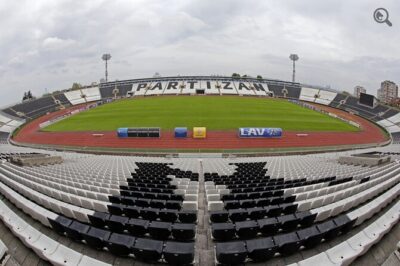
Private Red Star-Partizan Stadium Tour in Belgrade
Read our review →

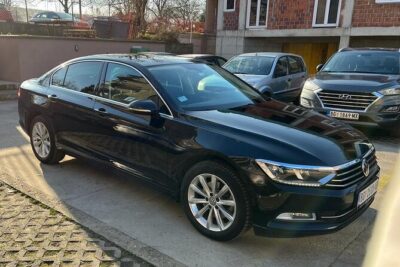
Private transfer from Belgrade or Belgrade Airport to Novi Sad
Read our review →
Private Day Tour to Fruska Gora Monasteries, Sremski Karlovci and Novi Sad
Read our review →
Private Novi Sad, Titanic wine tasting and Farmer’s House
Read our review →
The lists this tour appears in