
Reviewed · TOURS
Communist Tour in Belgrade
This tour is interesting because it treats Belgrade like a living timeline. You start in Trg Republike, then move through big socialist-era structures and the places tied to 1990s turmoil and 1999 NATO bombing, ending at the Museum of Yugoslavia where Tito’s story gets the full treatment.
I love the way the guides connect politics to real buildings and real streets, and how they keep it fact-based and balanced. If you get a guide like Stefan, you’ll appreciate the careful English and the nuance, and guides like Michael or Milan also bring the topic to life without turning it into a rant.
One drawback to consider: the subject matter is heavy and political, so it may feel intense if you prefer purely scenic sightseeing. Also, several stops are brief outdoors, so you’ll want good shoes and a bit of patience for walking and listening.
Key Things You’ll Notice on This Communist Belgrade Tour
- A guided storyline, not random monuments, tying Tito, the Non-Aligned Movement, the 1990s, NATO bombing in 1999, and democratic changes together
- Short stop, strong context at key squares and government buildings, so you get orientation fast
- Socialist realism you can see in the walls, especially at the Dom Sindikata
- Damage and memory are part of the route, including the Generalštab building’s bombing scars
- One included deep stop with a full hour at the Museum of Yugoslavia, plus the trolleybus ride
Trg Republike: Starting With Tito, the Non-Aligned Movement, and the 1990s
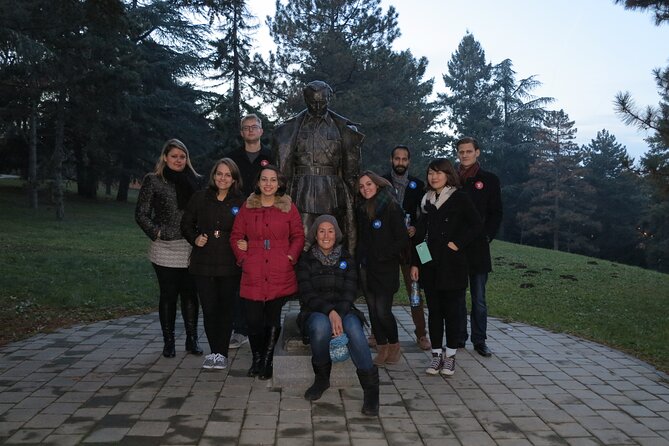
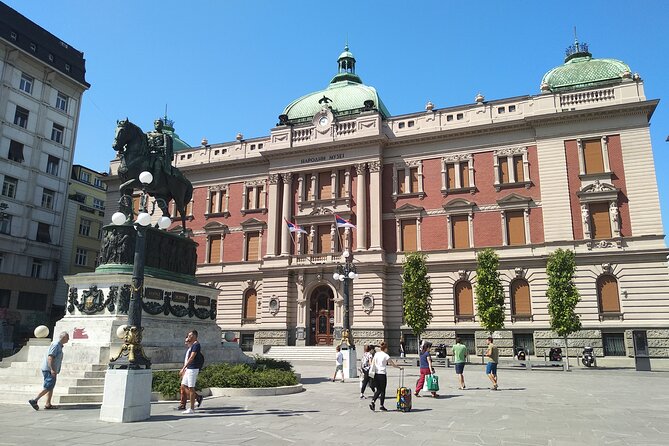
You begin at Trg Republike at 3:00 pm, a central square that makes a lot of sense as a starting point. Here, your guide sets the frame: Josip Broz Tito’s era, the youth relay baton symbolism, the Non-Aligned movement, and the chain of events that leads through the conflicts of the 1990s.
What I like is that this is not taught as distant textbook trivia. You’re standing in a real public space while the guide explains how Yugoslavia tried to balance East and West, then how the country fractured, and how Belgrade lived through the aftermath. That gives the rest of the tour a clear logic.
The Republic Square stop is also practical: the time is brief, and entry is free. You’re not stuck waiting around for a long intro while everyone gets restless.
Filling out a Belgrade stay? Consider these too:
- From Belgrade: Novi Sad & Sremski Karlovci Full-Day Tour
★ 4.7 · 1,068 reviews - From Belgrade: Gems of Eastern Serbia Tour
★ 5.0 · 427 reviews - Northern Serbia: Sremski Karlovci and Novi Sad Full-Day Tour from Belgrade
★ 5.0 · 425 reviews
Dom Sindikata: When Socialist Realism Shows Up in Everyday Belgrade
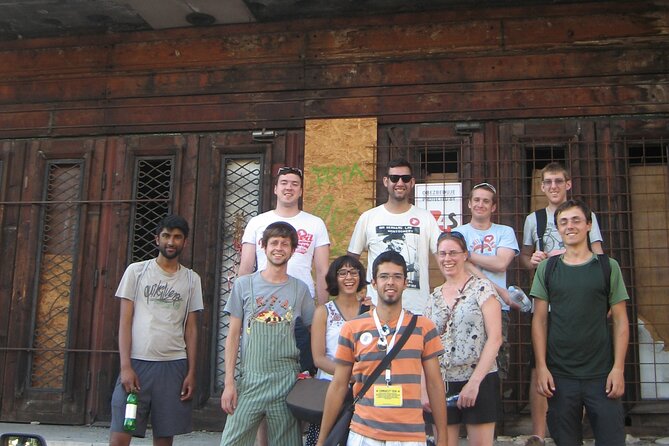
Next you head to Dom Sindikata, also known as the Trade Union Hall. This is one of those buildings where you quickly see what socialist realism was trying to communicate, even if you don’t know the art theory.
It was projected by Branko Petričić, with construction starting in 1947, and your guide uses that timeline to explain how state power shaped public architecture. The building is massive, and the style is hard to ignore because it looks designed to last, designed to project authority.
The stop lasts about 15 minutes and entry is free, so you can keep momentum. Still, if you enjoy photography or want to take a careful look at façades, you may want to linger for a moment after your guide’s main points. Just don’t sprint ahead, because the tour is built around the story the guide tells in order.
Nikola Pašić Square and the House of the National Assembly: Parliament as a Moving Target
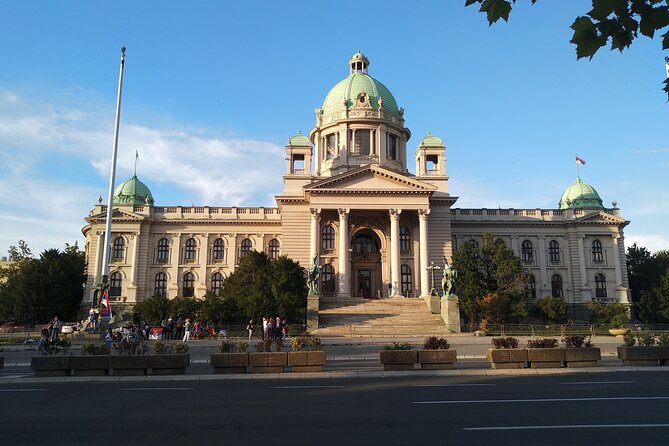
Then you reach the House of the National Assembly of the Republic of Serbia, located on Nikola Pašić Square. This is a landmark spot in downtown Belgrade, and it carries an important twist: between its completion in 1936 and 2006, it served as the seat of multiple parliaments, including the Parliament of Yugoslavia and later Serbia and Montenegro.
So you get to see continuity and change at the same location. That is a useful way to understand the political shifts without feeling lost in dates. The building becomes a timeline itself, and your guide likely points out how governments re-label institutions even when the same walls keep standing.
This stop is also around 15 minutes with free admission, which keeps the pace brisk. If you’re someone who likes to read plaques, you might want to give yourself a little extra time after the group moves on, or come back later on your own once you’ve got the bigger picture from the tour.
Kneza Miloša Street: Belgrade’s Korzo, Now Packed With Institutions and Embassies
From there, you walk along Kneza Miloša Street. It was the city’s main korzo, basically the classic promenade style street where people pass through, meet, and watch the city move.
Today it’s more of a political corridor, with traffic and with some of the most important national institutions. Your guide also ties it to the street’s dense collection of embassies, which helps you understand how Belgrade sits at a crossroads of international attention, not just internal ideology.
This stop is about 20 minutes and free. The value here is not just the street itself, but the contrast your guide builds: communist-era structures and systems are one layer, while the post-1990s city, full of diplomatic presences, is another layer. If you want a tour that makes modern Belgrade feel connected to the past, this is where the connection clicks.
Leave Belgrade for a day, differently:
- Day Trip from Belgrade: Gems of Eastern Serbia
★ 5.0 · 424 reviews - Belgrade: Sunset Cruise with Live Guide
★ 4.4 · 418 reviews - Western Serbia 1-Day Tour of the Key Sites from Belgrade
★ 4.8 · 333 reviews - Belgrade Nightlife Bar Pub Club Crawl with Drinks
★ 5.0 · 277 reviews
Generalštab: The Ministry of Defence Building and the Visible Memory of 1999
One of the most memorable parts of this route is Generalštab, the former Yugoslav Ministry of Defence building, also known as the Yugoslav General Staff. This is a masterpiece of post-war architecture, and that detail matters, because it reminds you how quickly a new identity gets built after conflict.
Then your guide turns to what happened later. The building was bombed and heavily damaged during the NATO bombing of Yugoslavia in 1999. That’s a big, blunt piece of history, and on this tour it’s treated with care, not sensationalized.
The stop is about 15 minutes and admission is free. Even in that short time, I think the impact can land. You’re not just hearing about bombing as an event. You’re seeing how a place carries consequences forward, physically and psychologically, in a city that still uses the space.
Museum of Yugoslavia: One Included Hour That Pulls Everything Together
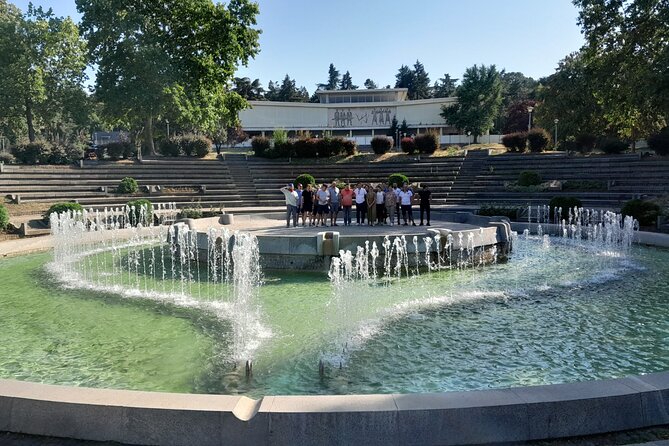
To reach the Museum of Yugoslavia, your group takes a trolleybus for about 15 minutes, and the ride is included. This is a nice touch because it keeps you from walking too long while still keeping the whole day’s story connected.
At the museum, you get 1 hour, and admission is included. The Museum of Yugoslavia is a public history museum in Belgrade that chronicles the Kingdom of Yugoslavia and Socialist Yugoslavia, with a strong focus on Tito’s life. One detail I really appreciate: Tito’s grave is located in one of the museum buildings, the House of Flowers.
That matters because it turns the tour from politics as theory into politics as human experience. Your guide can help you understand why Tito became a symbol, why Yugoslavia’s particular brand of socialism mattered to many people, and how later events changed the meaning of those symbols.
If you’re a museum person, you’ll probably want more than an hour once you start reading labels. Still, one hour is a solid guided hit, especially because it wraps up everything the tour introduced outside.
Price, Time, and What You’re Really Paying For
At about $24.03 per person for roughly 3 hours, this is priced like a short, high-impact orientation walk. You’re paying for three things: a professional guide, included museum entry, and the trolleybus ticket.
The best value is that the route gives you multiple layers without charging you extra for each site. Several stops have free admission for the public, and the big paid component is handled by the included museum ticket. In practical terms, that means fewer surprises and less time spent figuring out where you need to pay on your own.
A max group size of 15 travelers also matters. Smaller groups usually make it easier for your guide to keep the pacing and answer questions. And since it’s offered in English, you get a smoother experience if your Serbian is basic, like most of us.
Who This Communist Belgrade Tour Fits Best
This tour is a strong match if you want context, not just photos. It’s also ideal if you like hearing a complicated period explained with clear structure, including both distant and recent past.
In the reviews, guides like Stefan, Michael, and Milan stand out for doing exactly that: bringing modern Serbian history to life with fact-based explanations and careful presentation. I like that the tone sounds objective, not one-sided, and that some guides will even share book and documentary recommendations on request. That’s perfect if you want to keep learning after the tour ends.
If you hate politics on vacation, skip this. If you’re curious about how ideology, war, and diplomacy shape the buildings you walk past, you’ll likely enjoy it a lot.
Should You Book This Communist Tour in Belgrade?
Book it if you want a guided route that connects Tito-era Yugoslavia to the 1990s and 1999 NATO bombing, then closes with a museum visit that explains why all of that still matters. The mix of architecture stops, a promenade street, and one included hour at the Museum of Yugoslavia is an efficient way to get your bearings.
Skip it if you only want light sightseeing, or if you’re not comfortable with political themes that can feel emotionally heavy. Also, if you’re someone who needs long free time at each stop, the short outdoor segments might not feel enough.
FAQ
How long is the Communist Tour in Belgrade?
The tour is about 3 hours in duration.
What is the starting point and meeting location?
The tour starts at Trg Republike in Belgrade, Serbia.
Where does the tour end?
The tour ends in front of the Museum of Yugoslavia.
What time does the tour start?
The start time is 3:00 pm.
Is the tour offered in English?
Yes, it is offered in English.
How much does it cost?
The price is $24.03 per person.
What is included in the price?
Entrance to the Museum of Yugoslavia, a trolleybus ticket, and a professional tour guide are included.
Are the other stops free?
Admission is free for the outdoor stops listed before the museum.
What group size should I expect?
The tour has a maximum of 15 travelers.
Is free cancellation available?
Yes, you can cancel up to 24 hours in advance for a full refund.
Latest write-ups around Belgrade
- Private Wine Tasting by Party in Belgrade★ 5.0 · 3 reviews
- Private Half Day Serbia Tour Novi Sad and Petrovaradin Fortress★ 5.0 · 3 reviews
- From Belgrade: Private Nis and Devil’s Town Full-Day Tour★ 4.0 · 4 reviews
- Private Walking Tour of Belgrade and Old Zemun★ 5.0 · 3 reviews
- Belgrade: The White Emigration in Serbia in the Wake of the Russian Revolution★ 5.0 · 3 reviews
- Belgrade center walking tour with Rakija, Cocktails and Burgers★ 5.0 · 4 reviews
- From Belgrade:Uvac Nature Reserve Tour★ 5.0 · 4 reviews
- Novi Sad Saturday Full day trip★ 4.0 · 4 reviews
Tours, side by side.
Sremski Karlovci and Novi Sad Full-Day Tour from Belgrade
Read our review →
Western Serbia 1-Day Tour of the Key Sites from Belgrade
Read our review →
Day Tour to Nis, Serbia with tickets and pick-up
Read our review →
Belgrade Big Tour: Top Attractions and Belgrade Neighborhoods
Read our review →The lists this tour appears in