Reviewed · TOURS
Kosovo War Tour
This Kosovo War Tour is interesting because it strings the story together using real places around Pristina. You do not just stand and read plaques, you follow a timeline that starts with 1989 repression and ends with the 1998 to 1999 war. I especially liked the small group (up to 4) setup, and the stop at Hertica House, where you see how education kept going in secret during the 1990s.
I also liked the way the guide, Astrid, explains the context with care and keeps the details understandable in plain language. One possible drawback is that this is emotional subject matter. It is also only 3 hours, and food is not included, so you’ll want water and a light plan for timing.
Key things you’ll get from this Kosovo War Tour
- Small group up to 4 means more time to ask questions and get direct answers in English
- Hertica House home-school memorial shows how people resisted through education
- National Museum of Kosovo, second floor focuses on recent history so you are not left guessing
- Prekaz Jashari complex gives the conflict a powerful human anchor
- Optional Mitrovica adds the divided-city angle with the bridge and local stops
- Multiple layers of history show both medieval and Ottoman sites plus the late 1990s war
The smart reason to do this tour instead of piecing it together
If you want to understand Kosovo’s late 1990s conflict around Pristina, a normal sightseeing loop will not cut it. The challenge is that the story spans decades, and the clues are scattered across museums, monuments, and memorial houses. This tour works because it groups those clues into a single route with a clear flow.
You get a guided timeline that starts after Kosovo’s autonomy was revoked in 1989. The tour then moves through the tightening repression, the closures and firing described in the background, and the way resistance could not be quelled. From there, it connects protests and demonstrations calling for freedom, democracy, and equality to the escalation into armed resistance as a survival strategy.
And yes, you will see heavy memorials. But you also get structure. You leave with a better sense of why these places matter, instead of just checking off names.
Starting in Pristina at the Newborn monument
You meet in Pristina at the Newborn monument. From the start, the guide gives a short introduction so you know what you are looking at before you get hit with the details.
Right away, you make quick stops among the local monuments tied to the last war. This includes a stop at the Missing People memorial and the historic president Dr. Ibrahim Rugova. The route also includes the Statue of Bill Clinton as one of the public markers you pass through while framing the wider international spotlight around the conflict.
These early stops are useful because they set tone. The missing people and leadership memorials help you understand that this tour is not only about dates. It is about lives, families, and consequences.
National Museum of Kosovo: the second-floor focus that saves you time
The National Museum of Kosovo is a key moment. You spend time in the second floor dedicated to recent history. That matters because recent history is often the part visitors struggle with, since they may know medieval or Ottoman Kosovo but not the 1990s story that shaped modern politics and identity.
This stop gives you a foundation. You are not trying to learn everything from memory after the fact. Instead, you see the story in one place, and then the tour uses the outdoor memorials and houses to give that same story a physical, emotional form.
One practical point: museums can feel slower than outdoor stops, but here it pays off. You leave the museum with names and a timeline that make the later sites make sense.
Hertica House and the home-school memorial: education under pressure
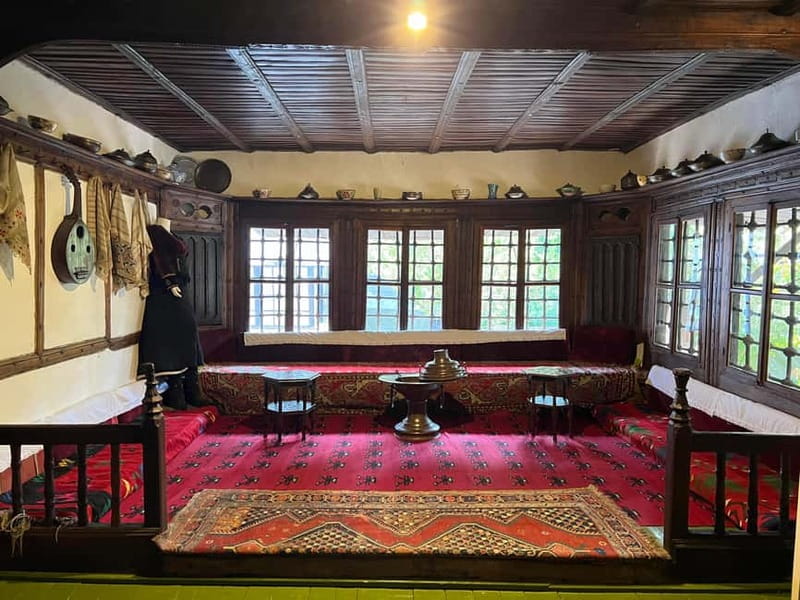
Next comes Hertica House, now a museum house and home-school memorial. During the period when the normal school system was disrupted, education was carried out secretly in in-home schools. That is the core idea behind this stop, and it is the kind of fact that stays with you.
You get around half an hour here. That is not long, but it is long enough to understand the purpose of the site and the human logic behind it. People did not just protest in the streets. They built a parallel system for learning, even when it came with risk.
What I liked about this stop is the way it shifts the story from violence to survival skills. Even if the rest of the tour is hard to hear, you still see agency. The conflict may have been brutal, but people were also stubbornly trying to preserve normal life, especially for children.
If you like history that has everyday texture, you’ll appreciate how this place explains the conflict through one of the most basic human needs: learning.
Prekaz and the Jashari complex: the memorial that frames everything
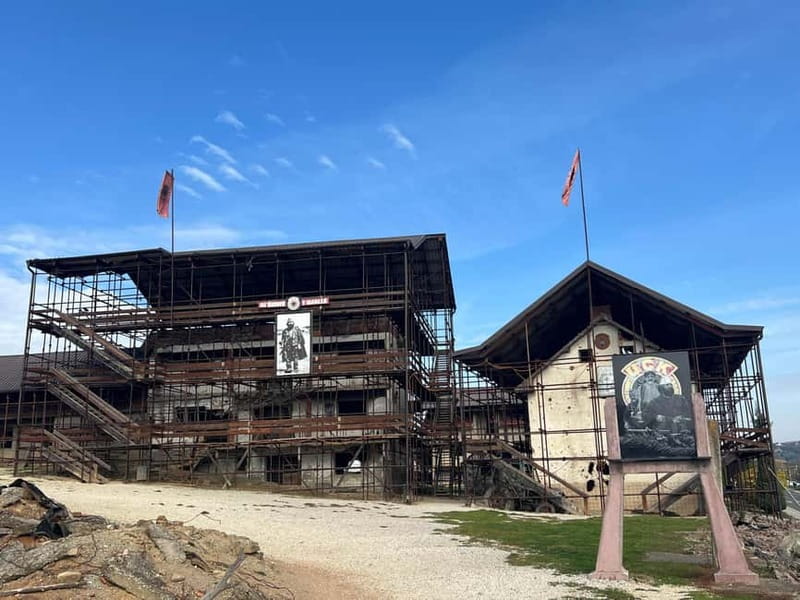
After Pristina, you head to Prekaz to visit the legendary complex of the Jashari family. This is one of the most important stops on the route, because it is a war memorial tied to the last liberation war story around Kosovo.
The tour treats this site with seriousness. It is not presented as a quick photo moment. You are supposed to slow down and read the meaning behind the memorial.
I found this stop especially effective after Hertica House and the museum. You start to see the pattern: repression, then resistance, then sacrifice. The Jashari complex becomes the place where that pattern crystallizes into a single location you can stand in.
Gazimestan: the 1389 battle monument and the optional tower climb
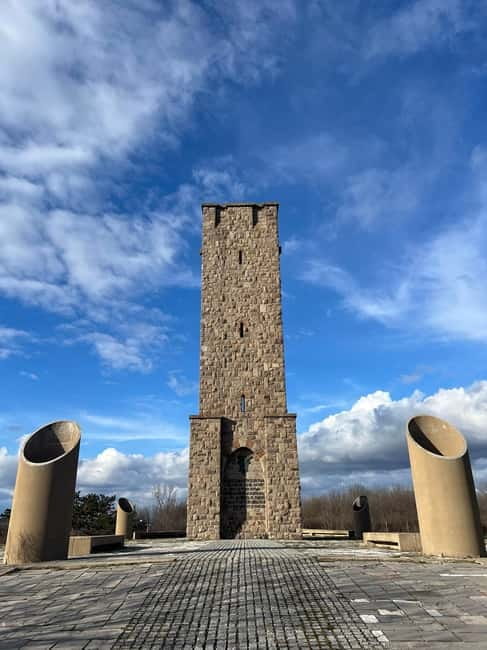
On the way to Prekaz, you stop at Gazimestan, a monument connected to the Battle of Kosovo (1389). This stop brings in a much older historical layer, which is important because modern identity in the region did not start in the 1990s.
There’s also an optional activity. If you want, you can step upwards the 28 meters high tower. Climbing adds value if you enjoy views, but keep in mind this is optional. If stairs or climbing are not your thing, you can still take in the monument without doing the ascent.
This is one of those stops where the contrast helps. You see medieval memory alongside late 1990s conflict memory, and that helps you understand how Kosovo’s past is used to shape political and emotional realities today.
Sultan Murad mausoleum and the Ottoman museum layer
You also visit the Mausoleum of Sultan Murad, tied to the Battle of Kosovo period. Nearby, there is a small Ottoman museum that shows Ottoman rule and daily life in the region.
This part is not just a history bonus. It gives perspective. When you only focus on the 1990s conflict, everything can feel like it happened in a vacuum. Adding the Ottoman layer helps you see that this region has been shaped by multiple empires and eras, and the memory of those eras still influences how places are interpreted.
If you enjoy thoughtful context, this stop will feel like a breather from the heavy memorial mood, even though it is still tied to battle history.
Optional Mitrovica add-on: the divided city viewpoint
By the end, you can add a visit to Mitrovica, a divided town with political and economic impact. This is an optional upgrade with an extra charge of 50 euros.
If you choose it, you visit the bridge that divides the town, and you also stop at a museum of crystals. Lunch is included as part of the Mitrovica portion, so this is the part where your timing becomes easier, because the main tour route itself does not include food.
Mitrovica can be a strong finish to the tour because it links the historical narrative to the present-day geography of division. Even though this is a war-focused tour around Pristina, this add-on helps you understand that the effects do not stay in the past.
Transport, pacing, and what 3 hours really means
The tour lasts 3 hours with transport included, plus a live English guide and companion. The small group limit to 4 participants is a big part of why the timing works. With fewer people, the guide can move at a human pace and answer questions without feeling rushed.
The route is also built around a few longer moments that anchor you: the museum time and Hertica House time. After that, the memorial stops act like chapters. That pacing is ideal if you want the highlights without spending a whole day driving around.
A practical note: because food is not included on the main route, plan for water. If you get sensitive to heat or you are visiting in warmer months, bring a bottle and a snack you can eat quickly if needed. You are moving through multiple sites in a short window.
Price and value: $235 per group up to 4
At $235 per group for up to 4 people, the value depends on how you travel.
If you are a couple or a small group, this pricing can make sense because you are paying for guided context, transport, and access support like skip-the-ticket-line. You also get time saved, since the guide handles the order and keeps the story coherent across multiple locations.
If you are solo, the per-person cost will be higher in practice, since it is priced per group. Still, for a war and history topic, getting a real guide can be worth it. This is not the type of subject where random online reading always gives you the emotional and chronological clarity you need on-site.
Bottom line: if you can split the group cost, it is strong value for a focused 3-hour route.
Who should book this Kosovo War Tour
I think this tour fits best if you want structured history with real places, and you prefer a guided narrative over independent wandering.
It is also a good match if you like tours that connect different time periods. You’ll see late 1990s conflict memory in Pristina and Prekaz, then you get older layers at Gazimestan and Sultan Murad.
You might skip it if you want light entertainment or a purely scenic day. This tour is built around monuments and the consequences of conflict. And because it is only 3 hours, it will not give you time to linger for long shopping or long café stops.
Also consider that the optional tower climb at Gazimestan is not for everyone. The route is marked as wheelchair accessible, which is a helpful point if mobility is a concern.
Should you book it or not?
Book this tour if you want an organized way to understand Kosovo’s 1990s repression and 1998 to 1999 war around Pristina, using the National Museum, Hertica House, and key memorial sites. The small group size and the guide’s careful, compassionate framing make a big difference on a heavy topic.
Skip it if you are looking for a casual, photo-only experience, or if you are not ready for memorial-heavy stops. But if you are willing to handle serious history and you want clarity fast, this is one of the better ways to do it in a short time.
FAQ
How long is the Kosovo War Tour?
The tour duration is 3 hours.
What is the price and group size?
It costs $235 per group for up to 4 participants.
Where does the tour start in Pristina?
You meet at the Newborn monument in Pristina.
What languages are offered?
The live tour guide is English.
What stops are included?
Included stops are the National Museum of Kosovo, Hertica House home-school memorial, Gazimestan monument area, the Mausoleum of Sultan Murad and an Ottoman museum, and the Jashari complex in Prekaz. The route also includes monuments in Pristina such as the statue of Bill Clinton, missing people monuments, and Dr. Ibrahim Rugova, based on the tour description.
Is food included?
Food or lunches are not included in the main tour.
Is the tour wheelchair accessible?
Yes, it is listed as wheelchair accessible.
Can I add Mitrovica to the tour?
Yes. Mitrovica is an optional add-on with an extra charge of 50 euros.
Is there a lunch stop in Mitrovica?
A lunch in Mitrovica is included as part of the Mitrovica portion.
Can I cancel for a full refund?
Yes. You can cancel up to 24 hours in advance for a full refund.
Tours, side by side.
Sremski Karlovci and Novi Sad Full-Day Tour from Belgrade
Read our review →
Western Serbia 1-Day Tour of the Key Sites from Belgrade
Read our review →
Day Tour to Nis, Serbia with tickets and pick-up
Read our review →